

Local Info
Blog
Montenegro on Global Digital Nomad Platforms: From the Top of the Digital Nomad Index to Everyday Life on the Adriatic

Over the past few years, Montenegro has evolved from a "hidden gem" of the Balkans into one of Europe's most closely watched remote work destinations. If you browse global rankings, community-driven databases, and relocation portals, Montenegro increasingly appears near the top — though each platform views the country through a distinct lens.
1. VisaGuide.World Digital Nomad Index: A Global Bronze Medal
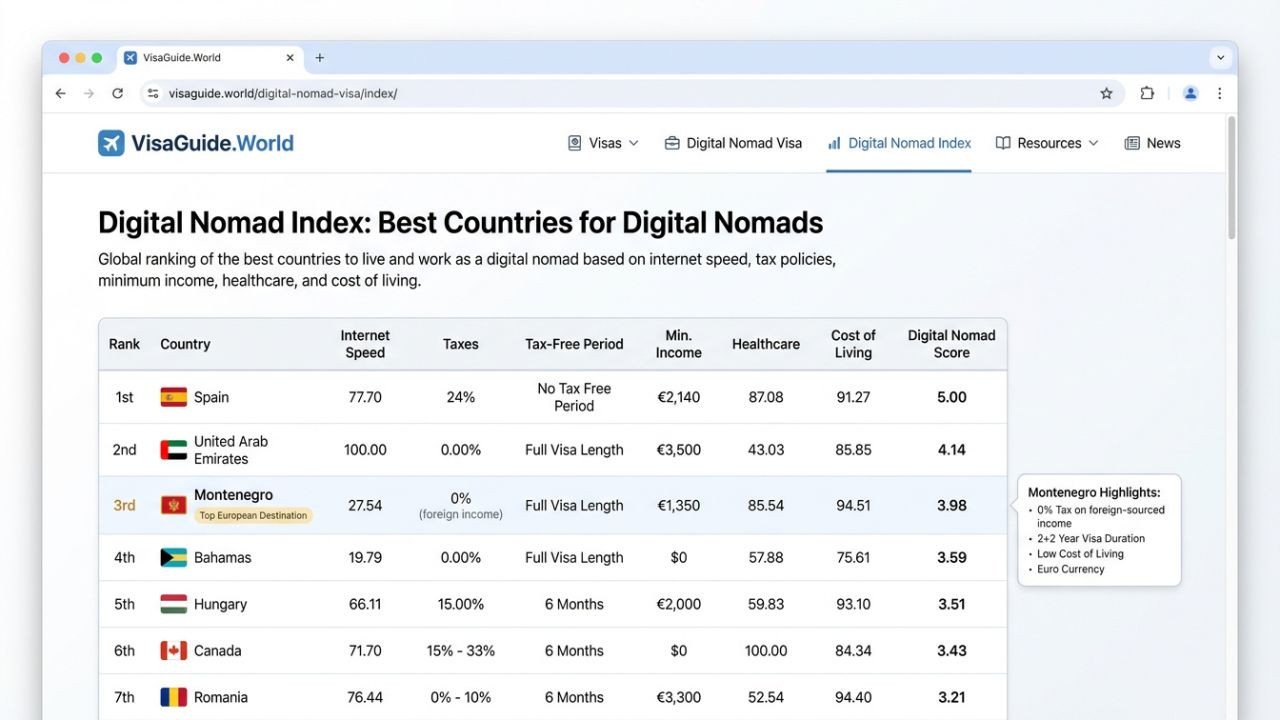
Montenegro's biggest media and industry breakthrough came from the VisaGuide.World Digital Nomad Index, where it ranked 3rd overall worldwide, positioned just behind Spain and the United Arab Emirates.
This index evaluates concrete metrics tailored to remote workers — internet infrastructure, tax policies, visa duration, cost of living, and lifestyle appeal. Montenegro scored so high in their global evaluations due to three key factors:
- 0% tax on foreign-sourced income: Holders of the D-type digital nomad visa are completely exempt from local income tax on earnings generated outside Montenegro.
- 4-year visa duration structure: The initial 2-year visa can be renewed once for an additional 2 years (giving nomads up to four consecutive years in the country) before requiring a 6-month break.
- High score for cost of living vs. lifestyle: Low day-to-day operating costs compared to Western Europe, paired with stable internet infrastructure and the practical convenience of using the Euro (€) as the official currency.
2. Global Citizen Solutions (Global Digital Nomad Report): Top Marks for Procedures
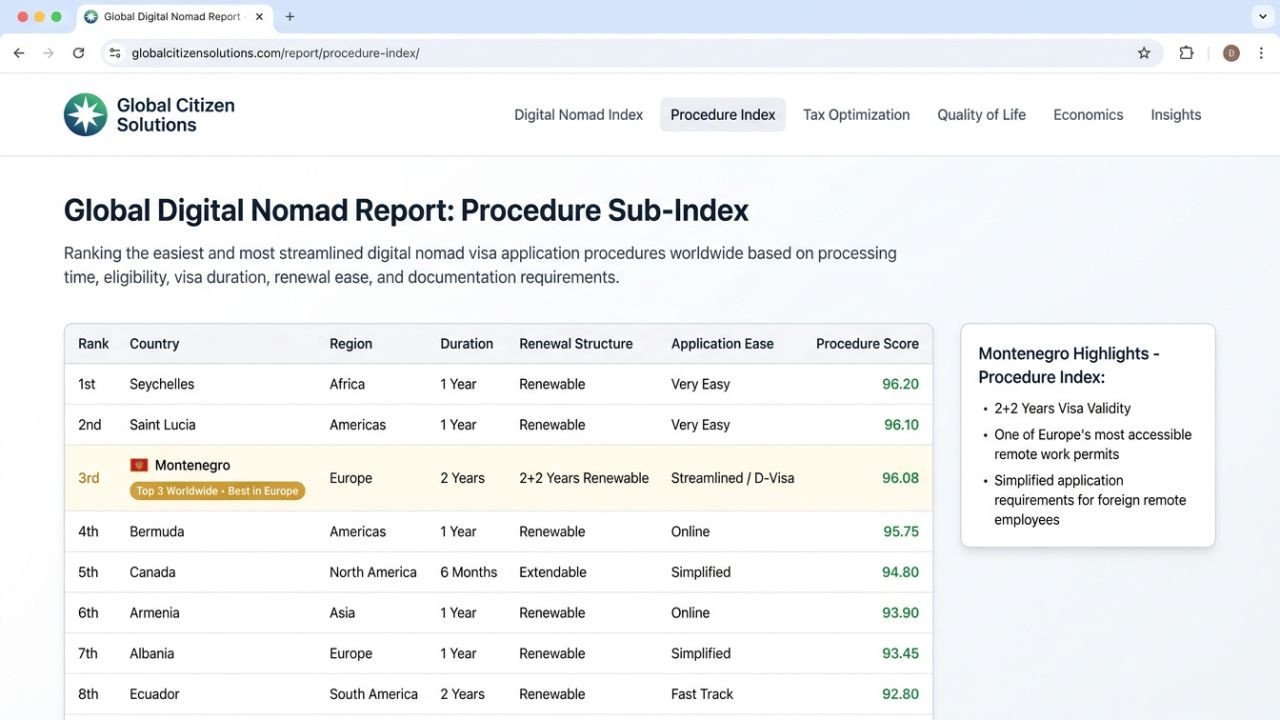
In the comprehensive report by Global Citizen Solutions — which analyzes 64 countries across migration policy, taxation, economics, and quality of life — Montenegro stood out in the Procedures category, ranking 3rd globally (behind only Seychelles and Saint Lucia).
The platform highlights Montenegro's multi-year renewable visa model as a standout feature in Europe, making it particularly appealing to slomads — remote workers who favor a slower pace and a long-term base rather than relocating every few months.
3. Immigrant Invest (Digital Nomad Visa Index): Focus on Taxes and Accessibility
Residency-focused advisory platforms like Immigrant Invest consistently rank Montenegro among Europe's most accessible options for obtaining a remote work residence permit. Their analyses emphasize the tax-free treatment of foreign-sourced earnings alongside a significantly lower minimum monthly income requirement than countries such as Malta, Spain, or Germany.
4. Nomads.com (formerly Nomad List) and On-the-Ground Communities
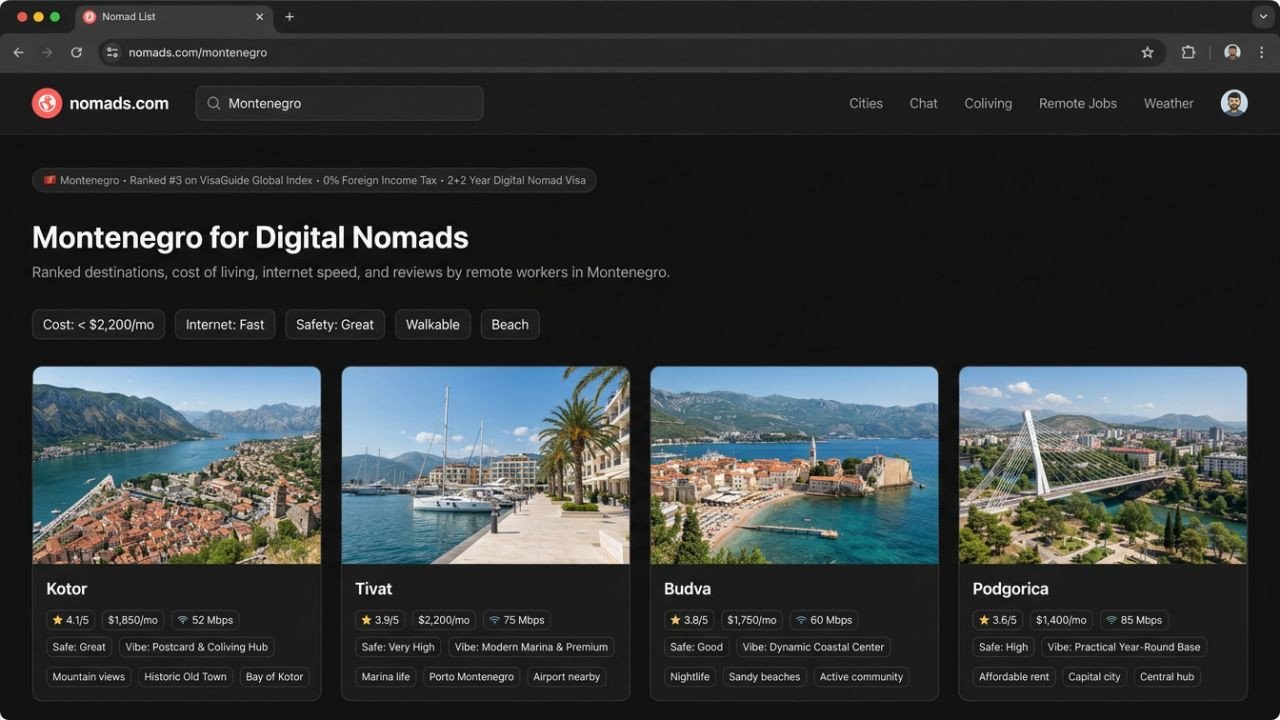
While formal indices measure legislation and tax codes, user-driven platforms — such as Nomads.com, ColivingDB, and WorkationBase — capture the day-to-day reality city by city:
| City / Region | How Nomad Platforms View It | Key Advantages | Challenges Noted in Reviews |
|---|---|---|---|
| Kotor & Bay of Kotor | Postcard base & coliving hub | Historic setting, proximity to Tivat Airport, growing coliving scene | Heavy summer cruise-ship crowds, higher seasonal rent |
| Tivat | Modern Mediterranean hub | Porto Montenegro, strong infrastructure, calmer pace than Kotor | Higher year-round apartment rental prices |
| Budva | Dynamic coastal center | Wide selection of apartments, beach access, solid coastal transport links | Strong seasonality (crowded in summer, quiet in winter) |
| Podgorica | Practical year-round base | Most affordable rents, fastest administrative processing, steady off-season life | Less coastal/tourist charm compared to the Adriatic |
What Global Platforms Flag as Key Challenges
Despite high rankings, more detailed relocation guides (such as Montenegro Guidebook, Wise, and legal relocation portals) point out several practical realities every nomad should factor in:
- In-Person Bureaucracy: Unlike countries with fully digitized application portals, applying for a Montenegrin residence permit still requires in-person visits to the Ministry of Interior (MUP), certified translations, and apostilled documents.
- The 30-Day Absence Rule: Temporary residency can be jeopardized if a permit holder spends more than 30 days outside Montenegro without prior notice or valid justification.
- Rising Rental Costs: The influx of tens of thousands of IT professionals and remote workers has significantly driven up long-term rental prices, particularly along the coast.
- Tax Residency Nuances: While foreign-earned income is exempt under the D-type nomad framework, anyone staying more than 183 days per year must carefully coordinate their tax residency status with their home country and applicable double-taxation treaties.
On global digital nomad platforms, Montenegro is no longer just an offbeat dot on the Balkan map — it is a serious contender alongside established Mediterranean hubs. From top placements on the VisaGuide.World and Global Citizen Solutions indices to active communities on Nomads.com and local coworking spaces, the country offers a rare blend of tax efficiency, Eurozone convenience, and a lifestyle where the workday ends overlooking a fjord-like bay or mountain peaks.
When you subscribe to the blog, we will send you an e-mail when there are new updates on the site so you wouldn't miss them.


Comments